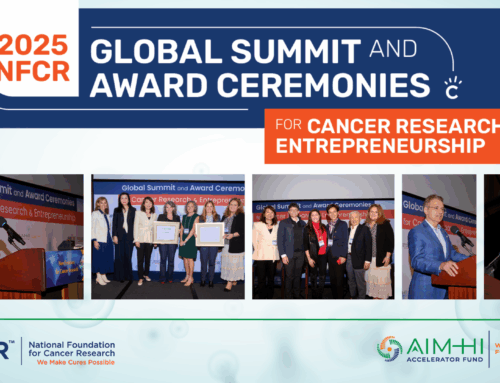
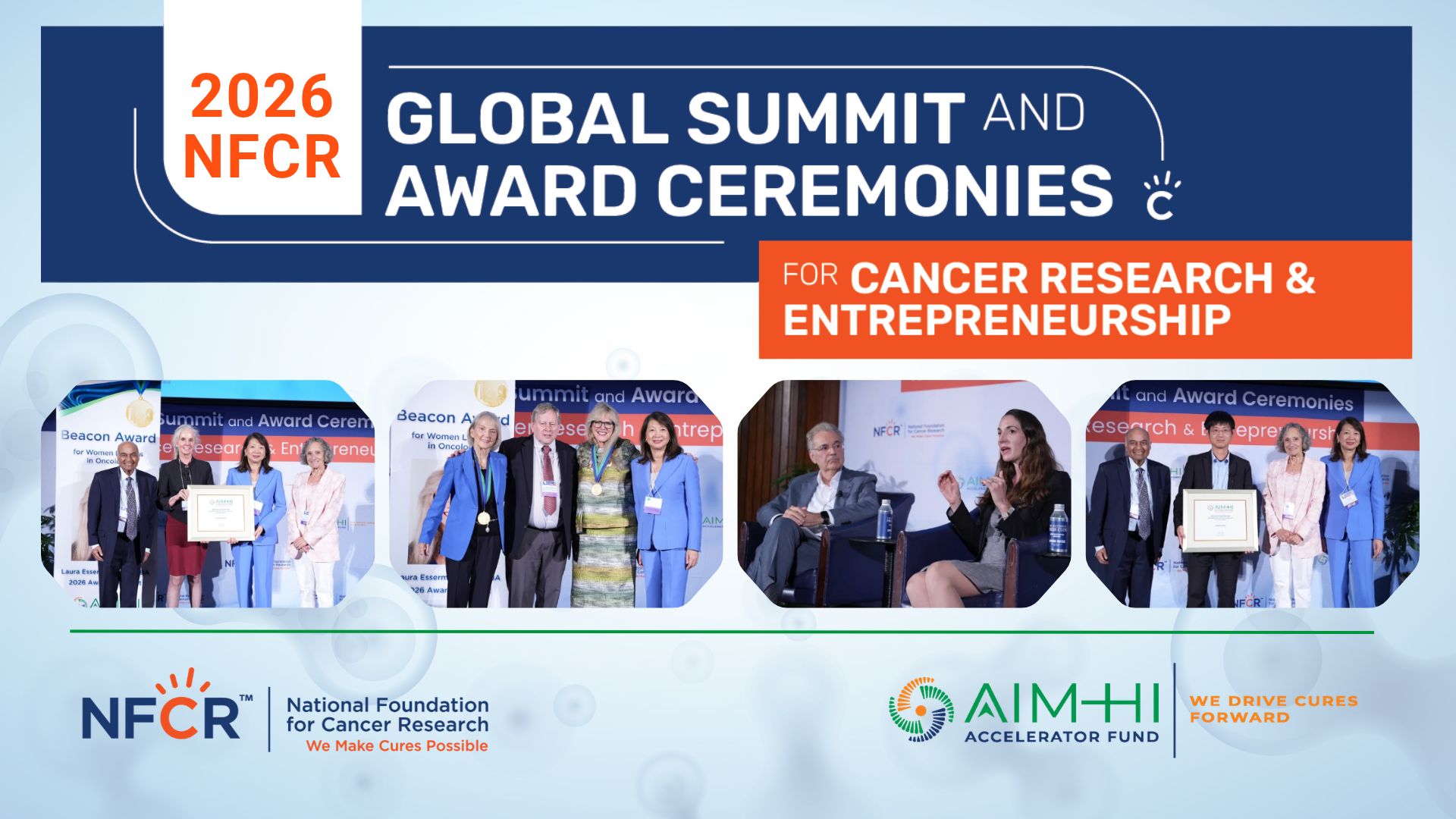
How does a discovery actually reach a patient? That question was at the heart of the AIM-HI Oncology Leadership & Entrepreneurship Forum at the 2026 Global Summit and Award Ceremonies for Cancer Research & Entrepreneurship. The National Foundation for Cancer Research and AIM-HI Accelerator Fund co-hosted the Summit on October 9 at the National Press Club in Washington, D.C.
At the forum, we honored a leader in oncology, celebrated two AIM-HI Venture Competition winners, and heard founders and investors speak candidly about what it takes to build an early-stage oncology company. Their conversation touched on the challenge AIM-HI was created in 2019 to address: the stretch between a promising idea in the lab and the first trial in people, where funding is hardest to find.
A Beacon for Women Leaders in Oncology
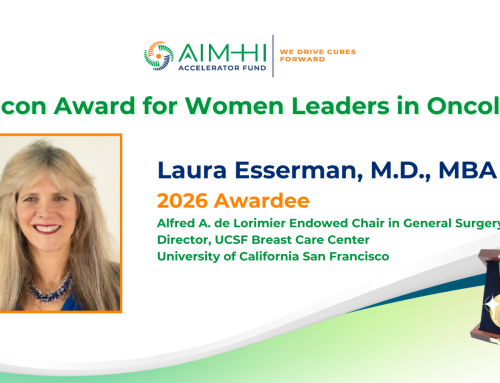
The afternoon opened with the AIM-HI Beacon Award for Women Leaders in Oncology, which this year went to Dr. Laura Esserman, Director of the UCSF Breast Care Center. The Blue Ribbon Selection Committee chose her unanimously. She follows Dr. Anna Barker, Dr. Monica Bertagnolli and Dr. Margaret Foti, who received the award in earlier years.
In her keynote, Dr. Esserman walked through three efforts that have shaped how breast cancer is studied and screened: the I-SPY adaptive clinical trials, the WISDOM trial of risk-based screening, and RISE UP, her work on prevention. It was a fitting start to an afternoon about people willing to rethink how cancer research gets done.
Recognizing the Winners of 2026 AIM-HI Venture Competition
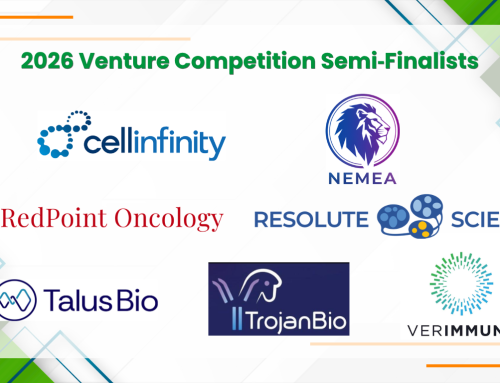
AIM-HI launched our Venture Competition programs to empower scientist-entrepreneurs in the oncology arena. This year, 60 applications came in from early-stage oncology companies from 10 countries worldwide. A first review narrowed them down to seven companies, which then presented to a committee for a scientific and medical evaluation. The committee then recommended the top two, and a separate handpicked investment committee then evaluated each company’s business model and executes due diligence before any funding is recommended.
Dr. Raju Kucherlapati, who outlined the process for the audience, stressed that the help doesn’t stop at a check. Dr. Sujuan Ba, NFCR’s CEO and AIM-HI’s co-founder and CEO, sometimes pulls together investor syndicates from around the world, and winners get expert advice and relevant infrastructure as they build.
Dr. Pam Garzone, who has worked with AIM-HI since 2019, then announced the winners. Resolute Science took the Women Venture Competition, and Cellinfinity Bio won the BRACE Award, which stands for Bridging Research from Academia to Cancer Entrepreneurship.
The Winners Take the Stage
Dr. Eva Martin introduced the winners. She has served on the scientific judging panel for six years, joined the investment committee this year, and, as she told the room, once interned for Dr. Esserman. She opened with a thank-you that captured the spirit of the afternoon: volunteers at NFCR, she said, “get back 10 times, 20 times more than ever we could give.”
Resolute Science. Dr. Faith Barnett, a neurosurgeon and the company’s founder, presented RS-5, a first-in-class therapy designed to work across many solid tumors. Her starting point was a surprising one. Tumor-associated macrophages (TAM) are immune cells that can make up 30 to 50 percent of a tumor, and they usually help the cancer grow. Instead of fighting them, Resolute puts them to work, using them to receive, process and deliver cancer-killing payloads inside the tumor. Because macrophages aren’t the mutating cancer cells, the approach sidesteps many of the ways tumors become resistant. “In our hands,” Dr. Barnett said, “the more TAMs, the better.”
The results were hard to ignore. When the team attached a fluorescent tag to the TAM attached molecule (MAC-TAC), a brain tumor lit up five minutes after injection while the healthy brain around it stayed dark. In a sarcoma model taken from a patient whose tumor kept growing through doxorubicin, RS-5 left no measurable tumor. Paired with radiation, it extended median survival in a glioblastoma model by 163 percent. Resolute has raised $11 million so far, including support from the National Cancer Institute (NCI) and CureBound, and holds orphan drug designation for soft tissue sarcoma. The IND is on schedule for December, with a first-in-human trial planned for early 2027. The team estimates it needs $12 million to establish safety and the right dose, and $20 million to reach clinical proof of concept.
Cellinfinity Bio. Dr. Sidi Chen, a Yale faculty member and serial entrepreneur, is tackling a different problem: making cell therapy work for solid tumors. CAR-T has transformed the treatment of blood cancers, but solid tumors, which make up roughly 90 percent of cancers, have been much more difficult. The cells struggle to get inside the tumor, wear out when they do, and the manufacturing is complex and expensive. An approved CAR-T can cost around $460,000 per patient. Dr. Chen’s answer is to build the cells inside the patient instead, which he said could bring the cost closer to $10,000. This cost reduction makes testing and treatment much more accessible.
The team engineered a more sophisticated delivery vector, then used large-scale genetic screening to let the biology reveal which genes to edit rather than guessing. In one stress test, its CAR-T cells showed no sign of exhaustion after 29 rounds of cancer-cell challenge. The lead program, CIB-301, targets a protein found in more than 93 percent of kidney cancers. In animal models, a single dose cleared tumors, including metastatic disease, the cells persisted for at least 90 days, and tumors did not return when the animals were re-challenged. Manufacturing is complete, a Beijing hospital has approved an investigator-initiated trial that could start in December, and the team plans to file an IND in 2027. A second program, CIB-350, is aimed at lymphoma, leukemia and autoimmune disease.
Panel Discussion: Innovation Meets Investment
The day’s last session was a candid conversation moderated by Dr. Ronald DePinho. He was joined by both winners, Dr. Barnett and Dr. Chen, and by Dr. Martin, who brought two diverse perspectives: years of business development at Roche and Genentech, and, as of two weeks earlier, life as a brand-new founder.
Dr. DePinho opened with a line he often repeats: no Nature paper has ever cured a patient. Value comes when knowledge becomes a drug, a diagnostic or a policy, and getting there takes great science, a sharp clinical hypothesis, a strong CEO, and a plan for paying for a very long road.
A few takeaways stood out:
- Pick partners, not just the best terms. Chen said his companies have chosen strategic investors over better offers, because those investors bring clinical expertise and staying power. “Choosing a partner is equally important or even more important than choosing just the money.”
- Try to kill the company first. Barnett started by funding the work herself, at the kitchen table, and ran the hardest experiments first so no one else had to take a risk until the science held up.
- Business development is like dating. Martin reminded founders that a pharma partner is weighing its own priorities, from pipeline timing to patent cliffs to a risk-adjusted business case, and not just your science. Start talking early and often, she said, and do what you said you would do. Trust is what gets deals done.
- Show early clinical data. Big Pharma told both founders the same thing. Dr. Chen is using investigator-initiated trials to learn as much as possible from small groups of patients, and Dr. Barnett’s trial will enroll all comers at sarcoma-heavy centers.
Audience questions pushed the conversation in important directions. Asked about boards, Dr. Martin said the right one opens doors to deal makers, while a slow or hesitant one can sink a good deal. On AI, Dr. DePinho said no biotech will succeed without embracing it, pointing to a company that reached a development candidate in nine months for $1.4 million, compared with the usual 24 months and $14 million. Dr. Martin pushed back gently: people still have an edge at spotting new uses for existing drugs, as with Rituxan for rheumatoid arthritis and Botox for migraine. And when an audience member asked about venture philanthropy, Dr. DePinho encouraged founders to look at foundations that fund early work, which helps companies cross the “valley of death” to the end of Phase 1, where a company’s value takes a big jump.
What Comes Next
Both winners are headed toward the clinic in the coming months, and both are raising money to get there. That is the point of AIM-HI: to help promising science reach the day it can finally be tested in patients.