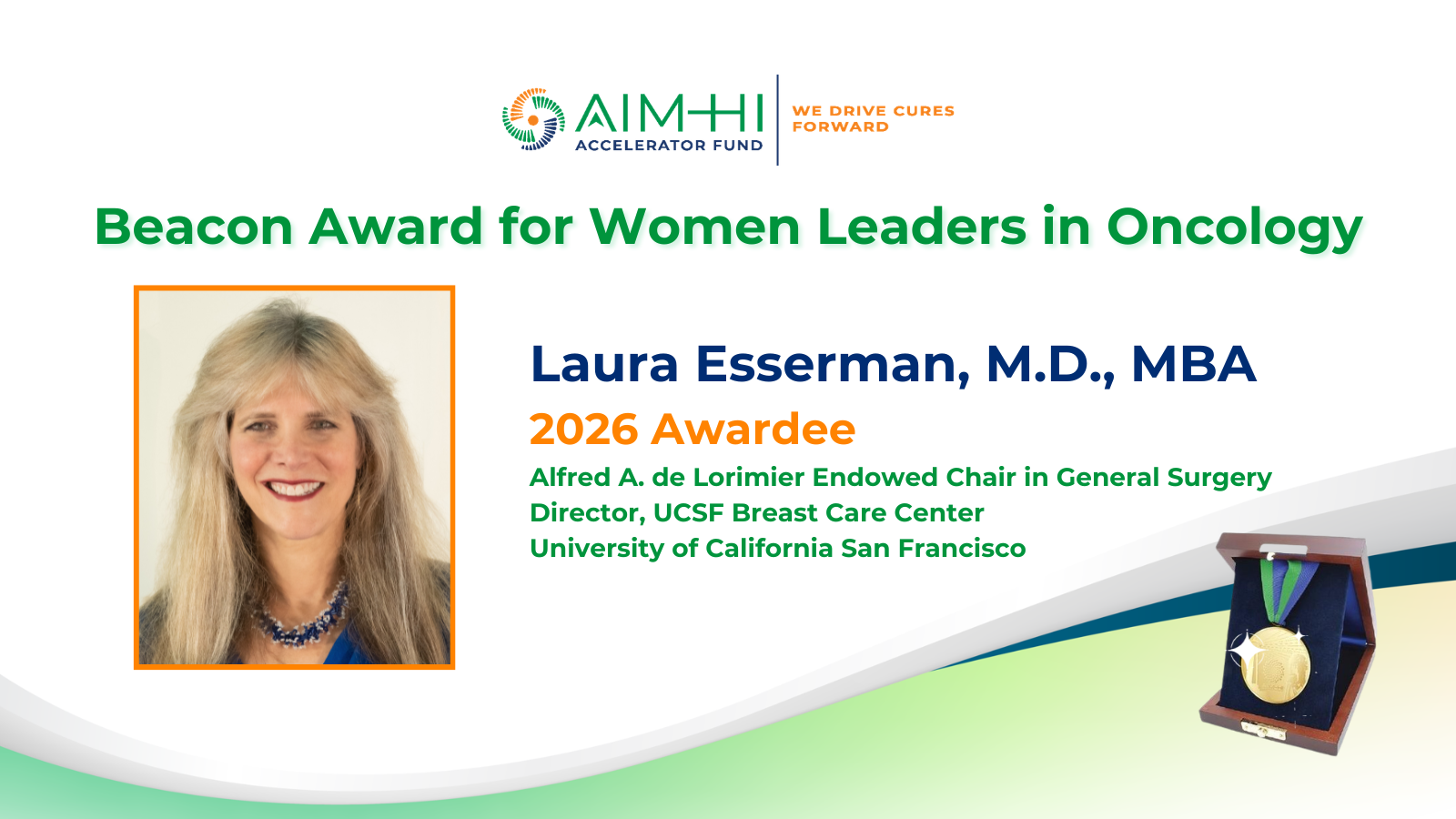
Rockville, MD (21 September, 2026) The AIM-HI Accelerator Fund today announces that Laura Esserman, M.D., MBA, Alfred A. de Lorimier Endowed Chair in General Surgery, Director of the University of California San Francisco (UCSF) Breast Care Center, and Professor of Surgery and Radiology at the University of California, San Francisco, is selected unanimously by the 2026 Blue Ribbon Selection Committee as the recipient of the 2026 AIM-HI Beacon Award for Women Leaders in Oncology, from a pool of outstanding global nominees.
The AIM-HI Beacon Award for Women Leaders in Oncology was established in 2022 by the AIM-HI Accelerator Fund and sponsored by the National Foundation for Cancer Research (NFCR). The Award recognizes outstanding women leaders in health and life sciences who have significantly impacted the global effort to improve and accelerate cancer treatment, detection, and diagnosis.
Dr. Esserman is an internationally recognized breast surgeon and a pioneer in personalized medicine. Since 2002 she has led the I-SPY TRIALs, a groundbreaking national public-private collaboration among the National Cancer Institute (NCI), the U.S. Food and Drug Administration (FDA), nearly 45 major cancer research centers, and dozens of pharmaceutical and biotechnology companies. The I-SPY platform uses imaging and molecular markers to classify tumors and track treatment response in real time. This allows therapies to be escalated or de-escalated based on an individual patient’s biology. More than 2,500 patients have enrolled in the trials, 25 drugs have completed evaluation, and 3 have advanced to accelerated FDA approval. Including a pathway that supported approval of pembrolizumab for advanced triple-negative breast cancer. Dr. Esserman co-founded Quantum Leap Healthcare Collaborative, the nonprofit organization that sponsors the I-SPY and RECAST trials.
A provocative and consistent voice against over-diagnosis and over-treatment, Dr. Esserman designed and leads RECAST DCIS, a long-term active surveillance registry showing that many lesions currently labeled as ductal carcinoma in situ can be safely monitored rather than immediately treated. She has authored or co-authored more than 500 peer-reviewed publications. She mentors trainees at every career stage through her post-baccalaureate research program and UCSF’s surgical oncology training grant, and has been named one of TIME Magazine’s 100 Most Influential People and, most recently, to the 2026 TIME 100 Health list. Her other honors include the Komen Visionary Award, the Komen Brinker Award for Scientific Distinction in Clinical Research, the Ernest C. Arbuckle Award from Stanford’s Graduate School of Business, and Fellowship in both the American Association for Cancer Research and the American Society of Clinical Oncology.
Dr. Esserman also led creation of the University of California-wide Athena Breast Health Network and serves as principal investigator of the WISDOM Study, a national trial that has enrolled more than 55,000 women to test whether personalized, risk-based breast cancer screening can safely replace a one-size-fits-all annual mammography schedule. Published in JAMA in December 2025, the WISDOM Study found that risk-based screening was non-inferior to annual screening, with no stage IIB or higher cancers among women in the highest-risk group who received more frequent screening. The study has inspired sister trials in Europe and Israel. Dr. Esserman is now leading its next phase, WISDOM 2.0, which will incorporate polygenic risk and mammographic artificial intelligence to further personalize screening and prevention.
“Dr. Esserman has spent more than two decades as a pioneer and innovator, proving that cancer care and research can be combined to transform clinical trials and build information-driven learning systems to deliver state-of-the art patient-centric care for all patients in need. Her work through multi-sector programs such as I-SPY and WISDOM challenged the status quo to demonstrate the power of learning health systems, which is now benefiting patients well beyond cancer. Through her work, she has also gone well beyond just changing how research and care can be connected to address problems such as over-treatment and quality of life challenges for breast cancer, and well beyond. She embodies exactly the individual that has combined bold ideas, research and multi-sector teams of oncologists, industry leaders and policy makers for the benefit of all patients, which is what at the AIM-HI Beacon Award was created to celebrate,” said Anna D. Barker, Ph.D., Chief Strategy Officer, Ellison Medical Institute, inaugural 2022 awardee for the Beacon Award, and Co-Chair of the 2026 Beacon Award Selection Committee.
“Throughout her career, Dr. Esserman has combined scientific rigor with genuine advocacy for patients. She built I-SPY into a model the entire field now looks to for how public and private partners can accelerate drug development together, and she has never stopped pushing to make sure that progress reaches patients faster and with less harm. Few leaders in oncology have had this kind of sustained impact,” said Webster Cavenee, Ph.D., Distinguished Professor of Medicine, University of California San Diego and Co-Chair of the 2026 Beacon Award Selection Committee.
“I am deeply honored to receive the 2026 AIM-HI Beacon Award for Women Leaders in Oncology. This recognition belongs as much to the patients, collaborators, advocates, and trainees who have shaped I-SPY, WISDOM, RECAST, and REWIRE DCIS, and everything we have built together as it does to me. My hope has always been that we can move cancer care toward something more personalized, less harmful, and adaptive to risk and response. We can do it much faster by working across institutions and disciplines rather than alone, and by being willing to challenge long-held paradigms and acting upon what the trials are teaching us in real time. The goal is to keep learning – and to test and provide new options when our patients need them most. I am grateful to the AIM-HI Accelerator Fund and the National Foundation for Cancer Research for this honor,” said Laura Esserman, MD, MBA, Director of the UCSF Breast Care Center.
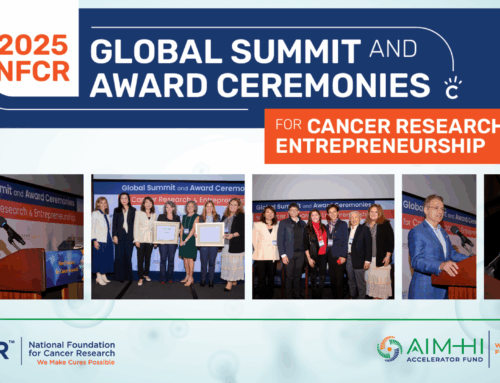
Dr. Esserman will be honored as the 2026 AIM-HI Beacon Award Ceremony at the National Press Club in Washington, DC, on October 9, 2026. The award ceremony is part of the 2026 NFCR Global Summit and Award Ceremonies for Cancer Research & Entrepreneurship, which brings together world-renowned leaders in cancer research and drug development, business leaders, investors, government officials, supporters, and patient advocates.
The Past Recipients of the Beacon Award for Women Leaders in Oncology:
- Anna D. Barker, Ph.D., 2022 Awardee, Chief Strategy Officer, Ellison Institute for Transformative Medicine, Distinguished Visiting Fellow, Complex Adaptive Systems, Arizona State University
- Monica M. Bertagnolli, M.D., 2023 Awardee, President of National Academy of Medicines, Former Director, National Institutes of Health and Former Director, National Cancer Institute.
- Margaret Foti, Ph.D., M.D. (h.c.), 2024 Awardee, Chief Executive Officer, American Association for Cancer Research
About the AIM-HI Accelerator Fund
The AIM-HI Accelerator Fund is a nonprofit organization dedicated to accelerating the translation of promising cancer research into new therapies, technologies, and companies that can benefit patients. By providing early-stage funding, entrepreneurial support, and connections to a global network of scientific, industry, and investment leaders, AIM-HI helps oncology innovators bridge the critical gap between scientific discovery and commercialization. Through its programs and partnerships, AIM-HI is building a sustainable ecosystem to advance breakthrough cancer innovations toward patients.
About the National Foundation for Cancer Research
The National Foundation for Cancer Research (NFCR) is a nonprofit organization founded in 1973 by Nobel Laureate Dr. Albert Szent-Györgyi and entrepreneur Franklin Salisbury, Sr. For more than 50 years, NFCR has supported bold, high-impact cancer research, providing scientists with critical funding to pursue promising ideas and accelerate discoveries toward better prevention, detection, and treatment. With the support of more than 5.7 million donors, NFCR has provided over $420 million for cancer research and education, contributing to important scientific advances that are improving lives and shaping the future of cancer care.